What to Buy for a New Patio Set Starter Kit
As an Amazon Associate we earn from qualifying purchases. This page contains affiliate links — if you buy through them, we earn a small commission at no extra cost to you.
You bought a new patio set at the height of summer, when the plan was long evenings outside, not a maintenance schedule. Now the nights are drawing in, the set still looks showroom-fresh, and you’re working out what “looking after it” actually means beyond wiping it down when it rains. The honest answer is that a new patio set needs more than an occasional wipe — and getting the basics right in year one is the difference between furniture that’s still solid in fifteen years and furniture that’s greying, cracking or rusting by next summer.
That’s what a starter care kit solves. Not a luxury purchase, but a way to cover every step that matters without researching each product from scratch or ending up with things that don’t work well together. Putting one together yourself runs to somewhere between £45 and £90 depending on your set and the products you pick, and it’s money well spent rather than an upsell.
Why New Furniture Needs a Plan, Not a Wipe
New garden furniture almost always arrives carrying factory residue — release agents, dust, the odd patch of wax or oil left over from manufacturing. That layer sits between the material and anything you apply afterwards, so the first job is always a clean, not a coat of oil. Skip it and you’re sealing grime in rather than protecting what’s underneath.
The UK climate turns this from a cosmetic concern into a structural one. Plastic left outside over winter goes brittle through repeated freeze-thaw cycles — a cracked slat on a bistro chair is physics, not a faulty batch. Wood rots wherever water sits or damp soil stays in contact with it, particularly on horizontal surfaces. Metal rusts at any chip or scratch in the coating, then spreads underneath the finish by capillary action. The RHS backs this up directly: carry out maintenance in dry weather at the end of summer, store furniture over winter where you can, and if it has to stay outside, keep the feet off wet ground and use a heavy-duty, breathable cover.
Treating this as a single spring clean misses the point — one clean isn’t a routine, it’s a delay. A new set needs three things done, in order, across its first twelve months: an initial clean to strip factory residue, a protective treatment matched to the material, and a plan for winter storage. Miss any one of the three and you’ve opened a window for damage that costs more to put right than the kit would have cost to buy.
Soap and water is enough for plastic and resin weave. Wood needs a dedicated furniture cleaner rather than washing-up liquid, which degreases the surface and strips the oils that keep the grain healthy — the same washing-up liquid is a bad idea on metal too, since it can leave a residue that speeds up corrosion. Metal generally just needs a mild cleaner and a rinse unless rust has already taken hold.
Protection is the step most people skip, because the furniture still looks fine. It isn’t fine, it’s just not showing yet. Untreated teak silvers fast under UK UV and rain as the surface lignin breaks down. Metal without wax or a rust-inhibiting treatment starts corroding at the first nick in the coating. Plastic fades and turns brittle sooner without UV protection. Which treatment you need depends entirely on the material — oil for hardwood, wax for metal, a UV spray for plastic — and that’s specific enough to need its own section per material, below.
Storage is the one job that isn’t optional if the set is staying outside. A breathable cover — not a cheap tarp that traps condensation and creates the exact damp conditions you’re trying to avoid — plus lifting the set slightly off the ground on its own feet or a couple of bricks, stops the base sitting in pooled water all winter.
That’s four things you actually buy: a cleaner, a protective treatment, a breathable cover, and basic tools — a soft brush, a sponge, an applicator cloth or brush. Everything else is optional.
Teak and Hardwood: What Actually Works
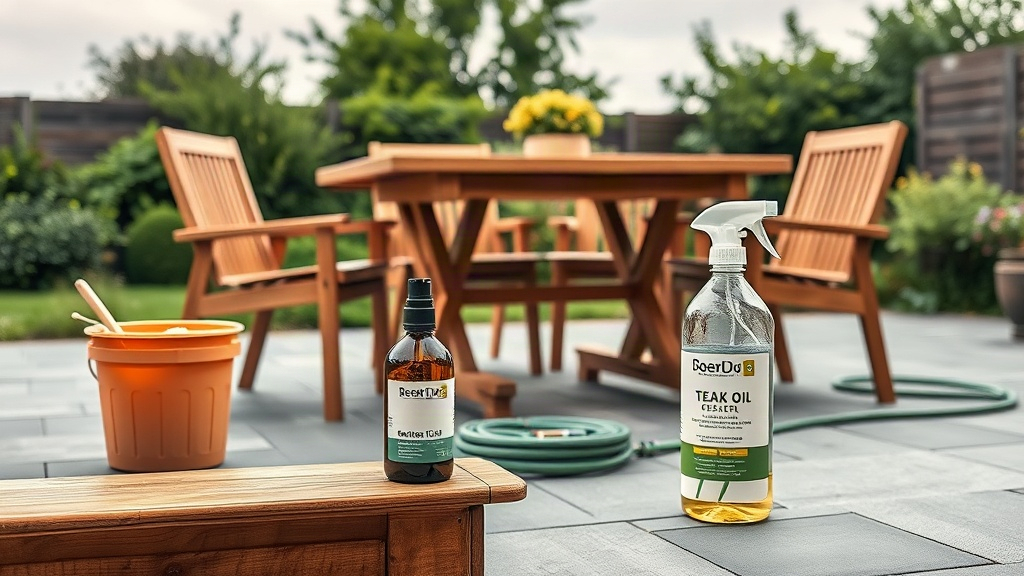
Ronseal Teak Oil (paid link) is the one most commonly mentioned by name in owner forums — it soaks in well, brings back the natural colour, and leaves water beading on the surface afterwards. Owners consistently find it easy to apply, though it needs multiple coats and uses more product than you’d expect.
Buy on Amazon → (paid link)
Rustins Teak Oil is the honest budget alternative. It’s lower in odour — worth knowing if you’re working somewhere enclosed — and leaves a natural-looking sheen. The trade-off is a slower cure: reviewers report it can take a couple of weeks before you can rub down between coats, so it suits patience over speed. Both are a better outcome than skipping treatment entirely, which is the only real mistake here.
Oil once a year, typically in spring or early summer when the furniture is dry and before the season’s heaviest use starts. If the wood looks grey and feels dry before the year’s up, that’s your cue to do it early rather than wait for the calendar — the moment water stops beading on the surface is an honest tell that the treatment’s spent.
Metal Frames: Stopping Rust Before It Starts
If your set has metal in it — cast iron, steel, aluminium — the weak point is any chip or scratch in the coating, because that’s where rust starts. Hammerite Kurust (paid link) is well regarded for treating small rust patches: brush it on, it converts light surface rust into a black, paint-ready surface, and you can then prime and overpaint. It needs proper prep — wire-brushing loose rust first — and it isn’t a structural fix for heavy corrosion, but for a new set with nothing worse than a nick in the paint, it’s a sensible thing to have in the kit. Holts Rust Converter, a long-standing name in rust treatment generally, works on the same principle and is handy for awkward areas a brush can’t easily reach.
📺 Watch: Removing Rust and Preparing Metal for Repainting — ChickFix USA
Plastic and Resin Weave: The Product Most People Skip
Plastic and resin-weave furniture doesn’t need oil or wax — it needs a UV-protectant spray that slows the fading and embrittlement sunlight causes. Fabsil Universal Protector (paid link) is the name that comes up most consistently, though it’s really built for fabric waterproofing (tents, cushion covers, awnings); for hard plastic surfaces specifically, a dedicated UV spray is the better call. Apply it to a clean, dry surface and reapply each season. Nikwax Tent & Gear SolarProof (paid link) also gets praise for adding UV protection to tired outdoor fabric, though it costs more and works best as a DWR refresh rather than a hard waterproof coating.
What This Really Costs — and Why the Stakes Decide It
| Component | Purpose | Typical Cost |
|---|---|---|
| Garden Furniture Cleaner | Removes factory residue and grime | £8–15 |
| Protective Treatment (Oil/Wax) | Adds a layer of defence against UV and rain | £12–25 |
| Breathable Waterproof Cover | Prevents damp and mould during winter | £20–40 |
| Basic Tools (Brush/Sponge) | Application aids | £5–10 |
Add those four up and you’re looking at roughly £45 to £90 for a full first-year kit, depending on how big your set is and which brands you pick. A small bistro set with modest-sized bottles sits at the bottom of that range; a six-seater dining set with a premium breathable cover and full-size tins sits nearer the top.
The number itself isn’t really the point. What decides this is the cost of getting it wrong. A new patio set that’s expensive to replace, and that you’re motivated to protect because it still looks new, is exactly the situation where skipping a step in year one costs you the whole set several years early. Weighed against that, spending under £100 on a structured routine — clean, protect, store, in that order — isn’t a close call.
Where people actually lose is completeness, not cost. It’s easy to nail the clean and remember the oil, then forget the cover — or buy the cover and run out of budget for the treatment. That’s where the damage gets in, because it only takes one skipped step, not all three, to undo the other two. If you already own some of the four components, or your set is small enough that one cleaner and one tin of oil covers everything, buy individually and save the difference. If you’re starting from nothing with a set you want to keep looking good, buying all four at once is the version that doesn’t leave a gap.
When You Can Skip the Kit Altogether
A full kit makes sense if you’re starting from zero with a new set. If you already own some of the components, buying the whole bundle again is overkill.
Already have a decent waterproof cover and a brush? You only need the cleaner and the protective treatment — a single bottle of cleaner and a tin of teak oil or metal wax covers the essentials for around £20–35.
Running a small bistro set — two chairs, one small table — a full-size kit is usually more than you need. A 500ml bottle of cleaner and a small tin of oil does the job properly; a kit sized for a six-seater dining set just leaves you with part-used bottles you’ll have forgotten about by next spring.
If money’s tight, the order to buy in is cover, then cleaner, then protective treatment — and the furniture needs to be properly dry before that cover goes on, since covering damp wood or metal just traps moisture against the surface and encourages the mould and rust you bought the cover to prevent. The cover stops most of what winter does on its own. Cleaning and treatment matter, but skipping the cover and relying on cleaning alone is the one move worth steering clear of — it’s shutting the stable door after the horse has gone.
As an Amazon Associate we earn from qualifying purchases. The kit linked above is gear we recommend based on independent research and owner feedback.
Where to Start If You’re Not Sure
None of this replaces reading the care label on your specific furniture, but the principles above — clean first, protect by material, store dry — hold for the overwhelming majority of UK garden furniture, whatever the brand.
If you’re not sure exactly what your set needs, the priority order is the same one from above: cover first, then cleaner, then treatment, buying only what you don’t already own. The free checklist walks you through building that kit from scratch for your specific set, without paying for anything you won’t use.
Related Guides
For a complete overview, see our Which Oil for Outdoor Wooden Furniture: Teak vs Softwood vs Hardwood UK.
Get the Free Garden Furniture Care Checklist and know exactly what to buy and in what order.