Waterproof Spray for Cushions: When It Actually Helps
As an Amazon Associate we earn from qualifying purchases. This page contains affiliate links — if you buy through them, we earn a small commission at no extra cost to you.
“Does waterproofing spray work?” is the wrong question to be asking about your outdoor cushions. The right one is what the covers are made from — because that single fact decides whether a can of spray genuinely protects the fabric or quietly helps it grow mould.
Most guides skip straight to product recommendations without ever asking that question, which is how you end up with a tenner’s worth of spray that either does exactly what it promises or makes a damp cushion problem measurably worse. This article works through the material difference that actually decides which outcome you get, and what a British winter does to make that difference matter more than it would somewhere drier.
The Two Ways to Protect Cushions
Outdoor cushions face two distinct enemies: rain soaking through the fabric, and the damp, still air that lets mould take hold. Protecting against them requires one of two approaches.
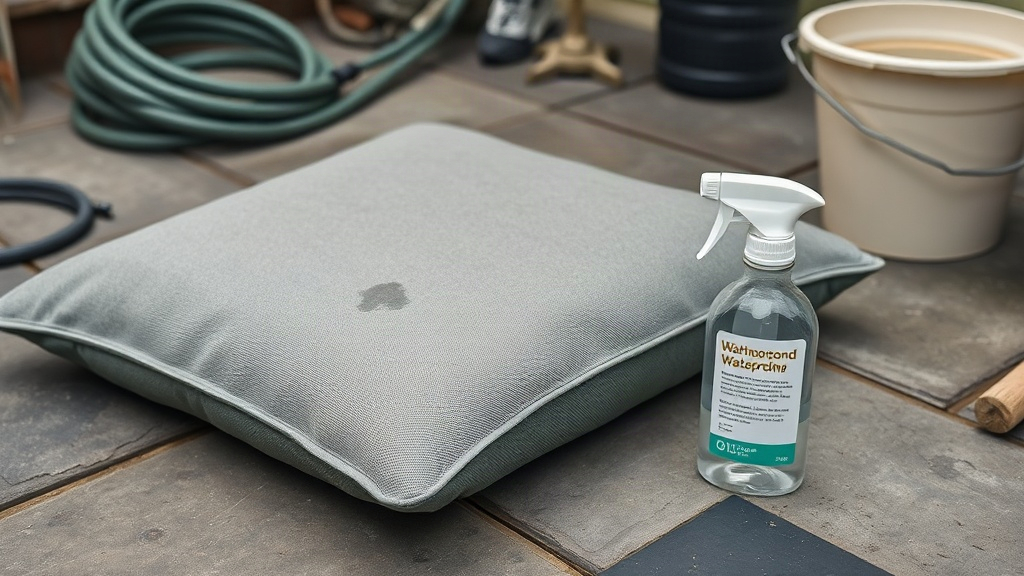
The first is surface treatment — a waterproofing spray applied to the fabric itself. Think of it like a raincoat for the fibres: it sits on the surface and makes water bead off rather than soak in. The second is physical isolation — waterproof slipcovers or sealed cushion inserts that create a complete barrier between the cushion and the elements. This is like putting the cushion inside a sealed plastic bag.
Both aim to keep cushions dry, but they work in fundamentally different ways. That difference matters enormously when you factor in what UK weather actually does to fabric over a wet autumn and winter.
| Waterproofing Spray | Waterproof Covers / Inserts | |
|---|---|---|
| How it works | Hydrophobic coating on fabric surface | Physical barrier completely isolating cushion |
| Application | Applied directly to cushion | Placed over or wrapped around cushion |
| Effectiveness | Repels surface water; limited on saturated fabric | Stops water reaching fabric entirely |
| Mould risk | Does not prevent internal moisture | Eliminates water ingress, reduces mould risk |
| Convenience | Low — apply once, works passively | Higher — remove to use, replace after rain |
Neither method is universally better. What matters is which one suits your cushion material, your climate exposure, and how much you’re willing to spend.
The Pros and Cons of Waterproofing Spray
Waterproofing spray has a genuinely useful role, and it’s worth being clear about where it actually helps rather than dismissing it outright.
Applied correctly, a good spray creates a hydrophobic barrier that makes water bead and roll off the fabric surface rather than soaking in. That’s a real win for cushions on a patio set that gets the odd shower — the rain bounces off, the fabric stays mostly dry, and you get a few extra years out of the cushion before it starts looking tired. For this use case, spray is straightforward, relatively cheap, and effective enough.
The catch nobody talks about enough is the preparation. The spray only works properly on a clean, completely dry surface — any dirt, oil, or residual moisture under that hydrophobic coating and you’ve sealed the problem in rather than keeping it out. If your cushions are already damp, smelly, or dirty, a spray applied on top is essentially cosmetic. You’re treating the symptom, not the cause.
There’s also a specific failure mode in the UK context. Spray repels water from the outside, but it does nothing for moisture that’s already inside the cushion — from condensation, from rain that’s soaked through before you applied it, or from damp cushion inserts that were never fully dried. In a British winter where cushions can stay damp for days or weeks at a time, that trapped moisture has nowhere to go. The spray has done its job repelling the next shower, but the mould problem underneath just continues.
The products worth considering — Fabsil Universal Protector (paid link), Scotchgard Outdoor Water Shield (paid link) — both have a decent owner track record for fabric water repellency when used on the right material. Owners consistently observe that multiple thin coats beat a single heavy application, and that the surface needs to be genuinely bone-dry before you start.
Check price on Amazon → (paid link)
So: spray is useful for keeping clean, dry polyester cushions water-resistant through the summer. It is not a rescue treatment for damp or already-damaged cushions, and it does not replace the need to dry cushions properly after wet weather.
The Material Trap: Why Cotton Needs a Different Strategy
Here is the bit that most product guides skip: waterproofing spray behaves very differently depending on whether your cushion covers are made from polyester or cotton — and in the UK, the distinction matters more than most realise.
📺 Watch: Testing Different Types of Water Resistant Fabrics — KBT Fabrics
Cotton is a natural fibre, and it’s hygroscopic — it absorbs a meaningful amount of moisture into the fibre itself and releases it again as the surrounding air dries. As a rough figure, cotton holds somewhere in the region of twenty times more moisture than polyester does at the same humidity. That’s a genuinely useful property in a lot of contexts. It’s also exactly what makes a sealed coating on top of it a problem.
When you apply a hydrophobic spray to cotton, the coating sits on the surface and makes water bead off, which sounds like a clean win. The catch is what happens once that beaded layer is eventually breached — by wind-driven rain, a heavy downpour, or condensation building up under a cover — because cotton has already absorbed a fair amount of that moisture into the fibre. A sealed surface slows down how quickly that moisture can work its way back out compared with untreated fabric, and a cushion that stays damp for longer is a cushion that’s more hospitable to mould. That’s the practical reason cotton and cotton-blend covers need reproofing far more often than polyester does — a single application is not a fix-and-forget job the way it can be on a synthetic fabric.
Polyester doesn’t have this problem because polyester is already hydrophobic. The fibres don’t absorb water in the first place — they repel it from the inside. A waterproofing spray on polyester adds an extra surface layer to that existing water resistance, but it doesn’t fundamentally alter the material’s behaviour the way it does with cotton.
This is the material trap in plain terms: spray on polyester cushions is a reasonable, if modest, protective step. Spray on cotton cushions is a harder case to justify — you’re trading a small reduction in surface water ingress for a real increase in the chance that trapped moisture outlasts the fabric’s ability to dry out, and that’s what grows mould.
The implications are straightforward. If you’ve bought a premium rattan set with cotton cushion covers — common on mid-to-premium rattan and rope-weave sets — the right move is to focus on keeping those cushions dry through covers or dry storage, not to reach for a spray and assume the job is done. For polyester cushions on a budget or mid-range set, a spray adds a useful layer of water resistance with less downside risk.
This is not a situation where “it depends” is an acceptable cop-out. The material tells you what to do. Cotton: covers or dry storage. Polyester: spray if you want the extra protection, but only after cleaning and drying the cushion first.
When to Use Slipcovers and Inserts
Slipcovers and waterproof inserts take a different approach entirely. Rather than treating the fabric surface, they create a physical barrier between the cushion and the outside world. No water reaches the fabric at all, which means no moisture gets trapped inside the fibres, which means no mould breeding ground.
📺 Watch: Outdoor Storage Unit - How to Build — Proper DIY
For expensive cushions — premium cotton covers, memory foam inserts, or anything you’d wince at replacing — this is the more defensible choice. The physical barrier wins on every job that matters: it stops rain ingress, it extends the cushion’s lifespan, and it eliminates the musty smell that comes from cushions left damp in a sealed environment. In a UK winter, where a patio set might sit unused for months under alternating spells of rain, frost, and brief sunshine, that complete isolation is worth the added inconvenience of having to remove the covers before you can sit down.
The trade-off is daily usability. Slipcovers work brilliantly when the furniture is set up for the season and the weather is reliable — you put them on before forecast rain, remove them for a BBQ, put them back on after. In the kind of erratic British summer where you get three days of blazing sun followed by a week of sideways rain, that rhythm can become a bit of a faff. Nobody wants to be wrestling waterproof covers off a corner sofa at six in the evening because the forecast changed.
The practical solution most owners settle on is a belt-and-braces approach: spray for everyday water resistance during the season (on polyester cushions), and covers or dry storage for the winter months or when cushions aren’t in regular use.
How to Apply Spray Correctly (If You Must)
If you’ve decided spray is the right call for your cushions — which is the reasonable choice for polyester — then the preparation matters more than the product you pick. The difference between a treatment that lasts a season and one that fails within weeks is almost always in the prep, not the brand.
The process is straightforward: clean the cushions with a mild soap and water solution, rinse if needed, then leave them to air-dry completely. This sounds obvious, but it’s the step most people skip or rush. Cushions that feel dry on the surface can still hold moisture deep in the stuffing — leave them in a warm, aired room for at least 24 hours before you start, longer if the insert feels at all heavy. The spray needs to bond to a clean, dry fabric surface; anything sealed in underneath will cause problems later.
Apply in dry conditions, when no rain is forecast for at least 24 hours, and ideally when the temperature is above 5°C. Shake the can well and apply multiple thin coats rather than one heavy application — this gives better, more even coverage and reduces the risk of the fabric stiffening or changing texture. Allow each coat to dry fully before applying the next. The owner consensus on products like Scotchgard Outdoor Water Shield (paid link) and Fabsil Universal Protector (paid link) is that they perform reliably on the right fabric, dry fairly quickly, and don’t significantly alter how the fabric feels — the main complaint is the chemical smell during application, which is why ventilation matters.
The honest guidance on reapplication is this: if you’ve deep-cleaned the cushions or if you notice water no longer beading on the surface, it’s time to reapply. For cushions used regularly through a British summer, that typically means once a season — late spring, applied after a thorough clean, is the practical window that most owners work to.
Realistic UK pricing for a branded waterproofing spray — Fabsil and Scotchgard both sell in 400 ml to 600 ml aerosols — runs from around £10 to £20 depending on size and brand, and a single can comfortably covers a full set of cushion covers on a typical dining set. It’s not a big investment, which is partly why it’s tempting to treat it as a silver bullet. It isn’t one — but on the right material, applied correctly, it does what it says on the tin.
Frequently Asked Questions
Can I use waterproof spray on velvet cushions?
It depends what the velvet actually is. Velvet describes a weave, not a fibre, so cushion covers sold as “velvet” can be cotton, silk, or — increasingly, for outdoor ranges — polyester velour. Genuine natural-fibre velvet behaves like cotton: it absorbs moisture, and a hydrophobic spray risks sealing that moisture in. Polyester velvet behaves like any other synthetic weave and takes spray reasonably well. Check the care label before you spray — if it doesn’t say polyester or a synthetic blend, treat it as natural fibre and lean on covers or dry storage instead.
How often should I reapply waterproof spray?
A good rule of thumb is once a season for cushions in regular use. If you’ve given the cushions a deep clean, reapply immediately after — the protection will have been removed along with the dirt. If you notice water no longer beading on the surface, that’s your signal the coating has worn off. Annual reapplication, applied in late spring on a dry day, covers most situations.
Are there sprays that work on all fabric types?
Not really. Most sprays are formulated for synthetic fibres or canvas — they perform well on polyester, acrylic, and synthetic blends, which is the majority of budget and mid-range outdoor cushion fabrics. Cotton, linen, and natural fibres need a different approach (covers or storage) because the spray chemistry behaves differently on breathable materials. Always check the label to confirm compatibility with your specific fabric before buying.
Do waterproof covers protect cushions from UV damage as well?
Yes — one thing covers genuinely do well that spray cannot is block UV rays, which fade colours and gradually degrade fabric fibres over time. This is often overlooked when people are weighing up spray versus covers. If your furniture sits in full sun for much of the day, UV protection is another reason to favour covers for the longer-term care of premium cushions.
As an Amazon Associate we earn from qualifying purchases. The products linked above are ones we recommend based on independent research and owner feedback.
Check the Label Before You Reach for the Can
So, back to the actual question: what are your cushion covers made from? That single fact settles almost everything else here. Polyester — spray it, once it’s clean and dry, and expect a reasonable, low-cost improvement. Cotton, or a natural-fibre velvet — skip the spray, and lean on covers, slipcovers, or indoor storage instead. Getting this backwards is the mistake that’s easy to make when a product page just tells you to “waterproof your cushions” with no mention of what they’re actually made of.
Whichever material you’re working with, preparation decides whether any of it holds up: clean cushions, fully dry before you start, applied in settled weather, and checked again each spring. Skip that step and the material barely matters — a spray or a cover on a damp, dirty cushion won’t fix anything.
Related Guides
For a complete overview, see our How to Clean Garden Furniture Cushions and Keep Them Looking New.
Now you know what to check before you buy anything — not the product, but the fabric. Get the Free Garden Furniture Care Checklist to keep this material-by-material logic in one place, covering your cushions, your frames, and everything else that needs protecting before autumn arrives.